
The Invincible
Overview
The Invincible, or Niezwyciężony in Polish, is a hard-science-fiction novel by the Polish writer Stanisław Lem. It was serialized in 1963 and then issued as a book, and it is generally associated with Lem’s major work of the 1960s; an English edition appeared in 1973. The novel combines military space adventure with speculation about evolution, cybernetics, intelligence, and the limits of human understanding. Its title suggests technological mastery, but the story steadily tests whether any human vehicle, weapon, or theory can truly be called invincible.
Plot
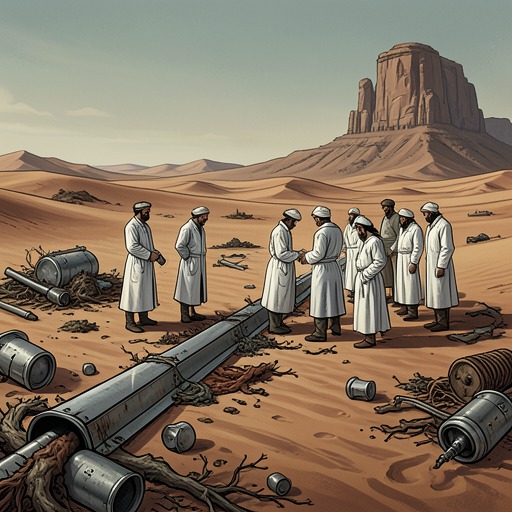
The formidable spaceship Invincible lands on the desert planet Regis III to investigate the disappearance of its sister ship, Condor, which stopped communicating after landing. The planet’s surface appears almost completely lifeless. The expedition finds puzzling geometric formations, but these prove to be lifeless metallic structures rather than the ruins of an abandoned city or a conventional extraterrestrial civilization. As the search continues, the crew encounters strange cybernetic “insects,” intelligent metallic forms whose collective behavior cannot be understood through familiar categories of animal life, machinery, or society.
The commander, Horpach, approaches the crisis through discipline, procedure, and the demands of the mission. The navigator Rohan is more introspective, and his reactions give the investigation a human and ethical dimension. What begins as a search-and-rescue operation becomes a confrontation with a mode of evolution that may have no individual minds, language, culture, or intentions recognizable to human beings. The crew has advanced science, formidable weapons, and organizational power, yet none of these guarantees comprehension. The danger arises not only from physical attack but from the possibility that humanity is mistaking an alien ecological process for an enemy that can be defeated or persuaded.
Themes and Method
The novel’s central concern is human arrogance. Human explorers instinctively interpret the unknown as an animal, a machine, a hostile force, or the remnant of a civilization. Lem makes each of these assumptions unstable. The metallic swarm suggests that intelligence need not be individual, verbal, emotional, urban, or even conscious in the human sense. A system can respond with extraordinary effectiveness without sharing human motives or values.
The Invincible also explores the relationship between technology and evolution. The metallic forms appear to represent an autonomous technological ecology, something that may have developed beyond the purposes of its makers. In this vision, technology is not merely a tool controlled by a civilization; over time it can become an evolutionary process with its own logic. Human weapons may therefore be less a solution than a source of misinterpretation and escalation.
Lem presents these ideas through concrete, almost technical descriptions of terrain, instruments, military decisions, and investigative procedures. The style gives philosophical questions practical urgency. What does rationality mean when information is incomplete and every experiment carries a cost? Does science mean that the world can be mastered, or does it begin with a disciplined acceptance of what cannot yet be known? The novel also retains a strong humanistic concern. Through Rohan and the other crew members, it examines the tension between completing a mission, protecting human life, and respecting an unfamiliar form of existence.
Background and Legacy
The Invincible belongs to the period in which Lem’s fiction became most closely identified with intellectually ambitious science fiction. His early work had been more closely aligned with the official expectations of socialist realism, but during the 1960s he brought medicine, philosophy, evolutionary theory, cybernetics, astronomy, and futurology into increasingly complex narratives. The novel stands alongside Return from the Stars and Solaris, both from 1961, and anticipates the concerns developed in His Master’s Voice and the Pilot Pirx stories, published in 1968.
Its lasting importance lies in the way it refuses the usual triumphal pattern of first contact. The alien presence is not simply a society waiting to communicate, nor a monster waiting to be destroyed. It is an ecological and evolutionary mystery that exposes the provincial character of human categories. Later discussions of artificial intelligence, swarm behavior, autonomous machines, and nonhuman cognition continue to make the novel feel remarkably current. Within Lem’s work and in the history of world science fiction, The Invincible remains a major hard-science-fiction classic: an exciting investigation whose deepest subject is the boundary between knowledge and self-deception.
About the Author
Origins and Education
Stanisław Herman Lem was born in Lwów on 12 September 1921, when the city belonged to the Second Polish Republic and before it became part of modern Ukraine. Lem later said that he had actually been born on 13 September, but that the date on his birth certificate had been changed because of superstition about the number thirteen. His father, Samuel Lehm, was a successful laryngologist and a former physician in the Austro-Hungarian army; his mother was Sabina Woller. Lem grew up in a Roman Catholic environment in a Jewish family, and later described himself as an atheist or agnostic. These overlapping cultural and historical circumstances contributed to his lifelong skepticism toward inherited certainties about religion, identity, and civilization.
He attended the Karol Szajnocha Second Grammar School in Lwów and intended to study at Lviv Technical University. The occupation of the city by Soviet troops made that plan impossible, and, through his father’s connections, he was admitted to medical studies instead. He later continued his training at Jagiellonian University in Kraków. The Second World War interrupted his education. During the German occupation he worked as a mechanic’s assistant and welder, and he survived by living covertly and using false documents. Many members of his extended family and of Lwów’s Jewish community were murdered. These experiences left him deeply wary of modern technology, organized violence, bureaucratic power, and the possibility of human self-destruction.
After the war Lem resumed medical studies but did not take his final examinations, partly because he wished to avoid military conscription. In 1946 his family moved to Kraków, where he would spend most of his life. He also worked as a research assistant at a scientific institution. Medical training, wide independent study in physics, astronomy, mathematics, evolutionary theory, and cybernetics, and the pressures of war and postwar politics all shaped his distinctive combination of scientific speculation and philosophical fiction.
Career and Major Works
Lem’s writing career extended from 1946 to 2005. His early books were influenced by the socialist-realist expectations of the period, a phase he later criticized. His 1951 novel Astronauts belongs to this early stage and carries some of its idealistic assumptions. During the 1960s he developed the mature style for which he became famous: technically attentive, intellectually playful, and deeply suspicious of humanity’s confidence in progress, communication, and rational control.
Return from the Stars and Solaris were both published in 1961. Solaris, his best-known novel, confronts human beings with an incomprehensible planetary ocean and examines memory, guilt, love, and the possibility of contact with an alien intelligence. The Invincible, serialized in 1963 and published as a book soon afterward, develops related questions through the metallic collective life encountered on Regis III. His Master’s Voice, published in 1968, follows scientists attempting to decipher a neutrino signal from space and focuses on information, interpretation, and the impossibility of confirming an extraterrestrial intention. Also published in 1968, the Pilot Pirx stories portray a space pilot’s practical and moral problems in a more realistic mode.
Lem wrote far beyond conventional science fiction. His work includes radio plays, screenplays, philosophical discussions of machines and technology, studies of futurology and literary theory, and reviews of both real and imaginary books. His subjects range across artificial intelligence, cosmology, genetic engineering, game theory, psychology, evolution, and mathematics. He often used satire, elaborate fictional scholarship, and invented critical forms to expose the limits of expertise and the habits of literary and scientific authority. Highcastle, his autobiographical work, looks back on his childhood and formation.
Later Life and Reputation
In 1953 Lem married Barbara Leśniak; they had one child. He continued writing and reflecting on the future of technology and civilization throughout his later life. He became increasingly critical of the conventions and commercial assumptions of American science fiction, even as his work gained a large international readership. In 1973 he was made an honorary member of the Science Fiction Writers of America, and he later received honorary doctorates from several universities. His books were translated into dozens of languages and sold tens of millions of copies. Solaris, The Congress, and Maska are among the works adapted for film.
Lem died in Kraków on 27 March 2006, aged eighty-four. He is widely regarded as one of postwar Europe’s most important and original science-fiction writers, as well as an author whose reach extended into philosophy, literary criticism, and the public discussion of science. Poland designated 2021 the Lem Year to mark the centenary of his birth, and asteroid 3836 Lem was named after him. His reputation endures not simply because he anticipated particular technologies, but because he treated the future as a test of human modesty. Again and again, his fiction asks whether people understand the machines they build, the universe they enter, or even the meaning of intelligence itself.
StoryFlow

The Condor Mystery
This flow follows the investigation of the lost sister ship from a false geological discovery to the evidence of a catastrophe without a visible attacker.
The Evolutionary Revelation
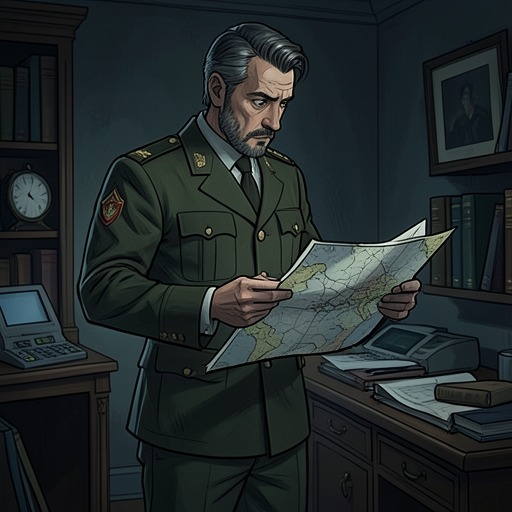
This flow traces how scattered geological and biological clues become Lauda’s theory of machine evolution.
Rohan’s Transformation
This flow traces Rohan’s movement from ambitious officer to witness who accepts the limits of human authority.
